Progressive Acceleration for Capability & Employability

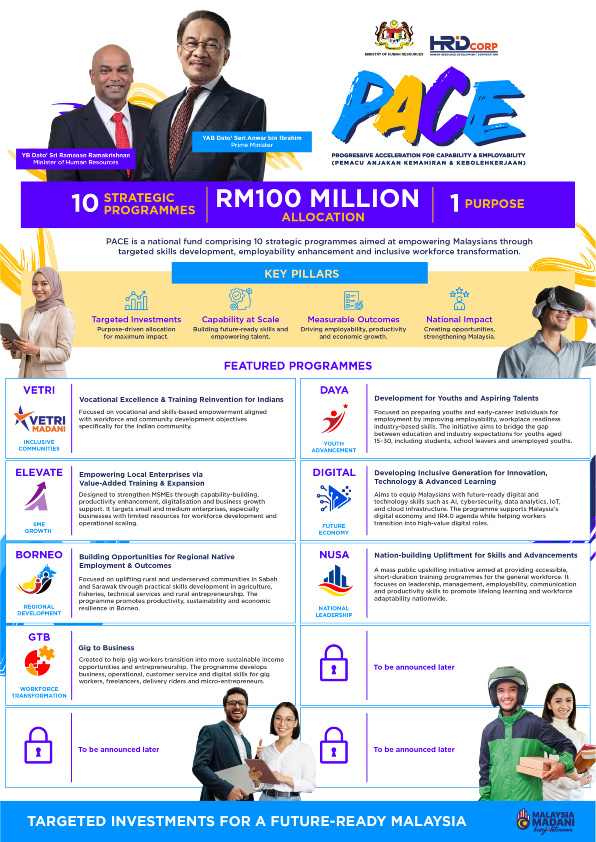
The Progressive Acceleration for Capability & Employability (PACE) is a national fund with a total allocation of RM100 million and comprises ten (10) strategic programmes.
The package was announced by the Prime Minister of Malaysia, YAB Dato’ Seri Anwar Ibrahim together with the Minister of Human Resources, YB Dato’ Sri Ramanan Ramakrishnan. It demonstrates the government’s commitment through the Ministry of Human Resources (KESUMA) and HRD Corp to accelerate human capital development, strengthen employability and ensure an inclusive work transformation under the Malaysia MADANI framework.
Focusing on future skills, new work opportunities and support for underserved communities, PACE serves as the main driver in building a Malaysian workforce that is competitive, skilled and ready for global challenges.
PACE is mobilised to empower Malaysians through skills development, employability and workforce resilience.

PACE offers several initiatives including:
VETRI MADANI
RM10 million to empower the Indian community through vocational training.

DAYA
RM10 million for the human capital development of youth and young talents.

ELEVATE
RM10 million to empower MSMEs through value-added training.

DIGITAL
RM10 million to build an inclusive generation in technology and innovation.

BORNEO
RM10 million to create job opportunities for the native communities in Sabah and Sarawak.

NUSA
RM15 million to develop national skills.

GTB (Gig to Business)

NADI
The proposed programme is open to a broad range of course areas that aligned with the programme objectives, target group needs and intended outcomes.
Certification Level
Open from 5 October 2026
Training programmes under NUSA must support the initiative’s objectives and cover leadership development, governance and integrity awareness workforce transformation and empowerment, future economy readiness, as well as interactive public engagement.
Certification Level
Open from 6 August to 31 Disember 2026
Proposed training programmes must align with the priorities of the 13th Malaysia Plan (RMK-13), focus on industry-driven technical courses that address current workforce demands, strengthen future workforce capabilities, support digitalisation, enhance productivity and meet the needs of high-value industries.
Certification Level
Open from 6 August to 19 August 2026
Programmes must align with RMK-13 priorities in supporting Malaysia’s transition towards a high-income economy driven by digitalisation, innovation and AI technologies. Courses should strengthen the national digital workforce through talent development and industry-relevant upskilling to improve adaptability, career progression and bridge the nation’s digital skills gap.
Certification Level

Open from 6 August to 19 August 2026
Programmes must align with (RMK-13), focusing on industry-driven and demand-oriented skills development to address current and future workforce needs. Training should support strategic sectors, including sustainable agriculture, fisheries and aquaculture, the blue economy, technical services, rural entrepreneurship and other sectors that contribute to higher productivity, stronger economic resilience and inclusive regional development in Sabah and Sarawak.
Certification Level
Open from 6 August to 19 August 2026
Programmes must align with RMK-13 priorities, with an emphasis on industry-driven technical courses to strengthen the future workforce, support digitalisation, enhance productivity and meet the needs of high-value industries.
Certification Level

Open from 6 August to 19 August 2026
VETRI MADANI aims to uplift the Malaysian Indian community by enhancing skills, improving career mobility and strengthening workforce readiness through targeted training programmes.
Proposed programmes must align with RMK-13 priorities and are of high industry demand, particularly in strengthening future workforce capabilities, enhancing productivity, accelerating digital adoption and supporting high-value industries.
Ready to participate in VETRI MADANI? Click the link below.
ELEVATE aims to empower local micro, small and medium enterprises (MSMEs) to help them bridge productivity and scalability gaps through the right training programmes.
Proposed programmes must align with RMK-13 priorities, especially in strengthening competitiveness, productivity and scalability of MSMEs through the aspects below, with the goals of having measurable business outcomes and supporting the formalisation and growth of MSMEs.